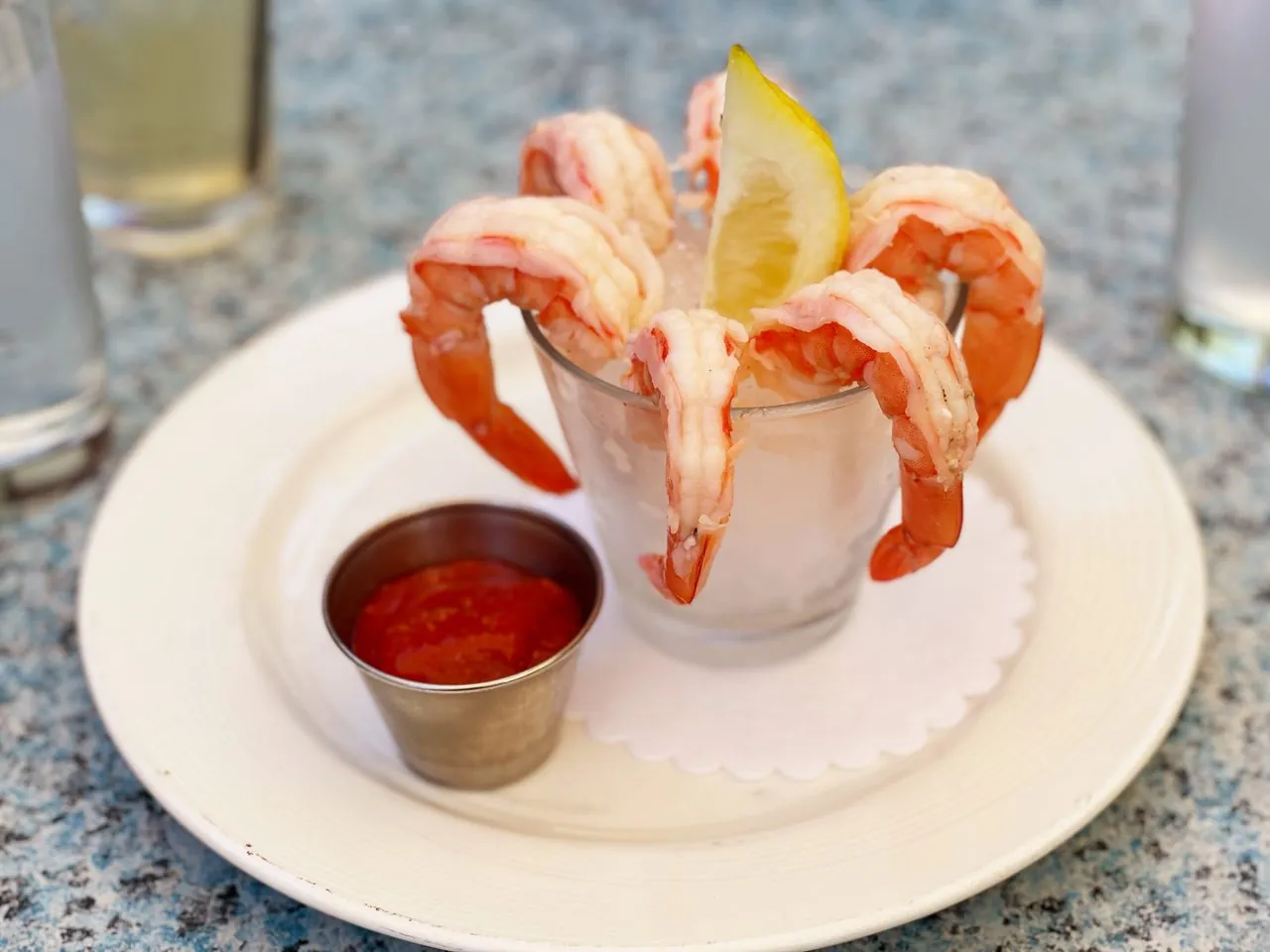
St. Elmo Steak House and the Fiery Shrimp Cocktail Legend
The Indianapolis steak house dates to 1902. Its horseradish shrimp cocktail, documented history and public game-day connection explained.
Harry and Esther Snyder opened In-N-Out Burger in Baldwin Park, California, in 1948. The chain's official timeline connects its early drive-through format with later expansion under family ownership. A limited core menu and the refusal to franchise are central to that business story. They are concrete operating choices, rather than evidence that its food, staff or customers have remained unchanged across nearly eight decades.
Harry Snyder was the tinkerer of the family, and his contribution to food history fits in a shoebox: a two-way intercom ordering speaker. Before Harry, drive-in dining meant carhops weaving between parked cars, memorizing orders and balancing trays. After him, the drive-thru had its grammar — pull up, talk into the speaker, drive away fed — and the entire industry would eventually be built on that pattern. It was a small invention with enormous consequences, and it captured the couple’s whole philosophy: engineer the experience around the customer, and never make the customer wait for ceremony. Harry handled the equipment and the kitchen; Esther handled the books and the discipline; by every account she was the counterweight to Harry’s ambitions — practical, exacting and unafraid to say no. The stand itself was tiny, but the idea inside it was not.
Esther Snyder deserves far more of the story than history usually grants her. She kept the company’s accounts from the beginning, steered it after Harry’s death, and lived long enough to see the chain become a national institution. Three generations of Snyders have now run In-N-Out, and it remains privately held — no outside shareholders to appease, no quarterly pressure to enlarge the empire. That independence explains a great deal: the deliberate pace of expansion, the refusal to cut corners, the famously steady workforce. Longevity here is not nostalgia; it is policy. The family treats the company less like an asset to be leveraged than a trust to be maintained, and customers can taste the difference. Expansion, when it came, came on the family’s terms alone, and the company has outlived fads, recessions and countless imitators precisely because it never chased them.
Walk up to any In-N-Out today and the board reads almost exactly as it did generations ago: burger, cheeseburger, Double-Double, fries and shakes. That is the core of the public menu, in an industry obsessed with limited-time offers and constant reinvention. The company’s reasoning has never changed — mastery beats variety. Do a few things, do them relentlessly well, and change nothing that works. The beef is fresh, never frozen, and the fries start as whole potatoes cut in the store. Families plan road trips around exits with an In-N-Out sign, which is a loyalty most brands cannot buy. The Double-Double alone has its own vocabulary and its own devout following, a two-patty monument to the idea that consistency is a flavor of its own. In an age of menu inflation, the shortest board in the business is also the most confident.
Then there is the famous secret menu, which has not been secret for a very long time. Ask for your burger Animal Style and it arrives transformed, richer and messier than anything the board advertises; ask for Protein Style and the bun is swapped for crisp lettuce. The phrase spread the way fast-food legends do, passed between friends and eventually embraced by the company that inspired it — the not-so-secret menu is now printed on the In-N-Out website, which is about as official as a secret can get. Generations of customers grew up believing they had discovered it themselves, then proudly taught it to their children. The arrangement suits everyone. Regulars feel like insiders; newcomers get a scavenger hunt; and the company gets a piece of folklore it never had to market. It is marketing that pretends to be gossip, and it works precisely because the core menu never needed it.
The chain's history provides fixed dates for its founders and early business decisions. Its present menu, geographical reach and opening hours are separate matters. Hot cocoa and other documented changes are reminders that a deliberately limited menu is not literally unchanged from the first day.
For an Animal Style or Protein Style order, use the company's current descriptions rather than a social-media compilation of supposed secret combinations. A preparation nickname does not tell an allergic diner every ingredient, and removing a bun does not establish that a meal is suitable for every dietary restriction or protected from cross-contact.
The refusal to franchise is useful to discuss as an ownership and operating choice. It does not prove that no company-owned store ever makes a mistake, or that every competing franchise has lower standards. The historical contribution is the particular combination of family control, a short product range and careful expansion. Those are concrete business choices, not a reason to invent comparisons with unnamed rivals.
A chain history, not a current store directory or a first-hand review.
The Indianapolis steak house dates to 1902. Its horseradish shrimp cocktail, documented history and public game-day connection explained.
How Matsuhisa, Robert De Niro and their partners built Nobu from a restaurant partnership into an international dining and hotel network.
Jiro Ono trained a generation of sushi masters from a ten-seat subway-adjacent shop. Why the Michelin guide eventually stopped listing it.